TONIGHT
Planning Meeting
Thursday 10th at St. Luke’s we have our termly planning meeting. Everyone is very welcome to come and help us map out and plan the Autumn term with Advent and Christmas. It’s an opportunity to discuss what we thought worked well over the Summer and what we’d like to see in the term to come.
Prayer requests for Pilgrimage
The Diocese Pilgrimage to Walsingham leaves on Monday morning and Jill has kindly agreed to take any prayer requests you may have with her. There’ll be slips in church on Sunday for you to fill out. If you prefer email them to Fr. Matthew and he will pass them on.
Pastoral letter
Dearest friends,
What a joy it is to be home! Pilgrimage is a wonderful and worthwhile endeavour, and I enjoyed every single day on the road… however… it is lovely to be back in my own bed and not have to pack everything onto the motorcycle each morning, wondering whether some vital item has been left behind in a field several hundred miles away.
I was away for thirty-five days and travelled 6,500 miles across Europe. It was an extraordinary privilege, although the great distances, the heat, the rain and the occasional mechanical difficulty meant that it was not always easy. That is part of what makes a pilgrimage different from a holiday. A pilgrimage is a journey made deliberately with God, in which the discomforts, interruptions and unexpected changes become part of the offering.
Our first great pilgrimage destination was Kevelaer in Germany, where devotion to Our Lady has drawn pilgrims for centuries. Prayer is woven into the life of the place. Pilgrims came and went, candles were lit, Mass was offered, and the prayers of generations filled the churches and chapels.
From Germany we rode east into Poland and came to Częstochowa, home of the Black Madonna. This was one of the places I had most wanted to visit, yet I was still unprepared for the intensity of devotion surrounding the icon. People did not gather to look at a celebrated work of religious art. They came to encounter Our Lady and, through her, to be brought nearer to Jesus. Faith was expressed openly, confidently and without embarrassment.
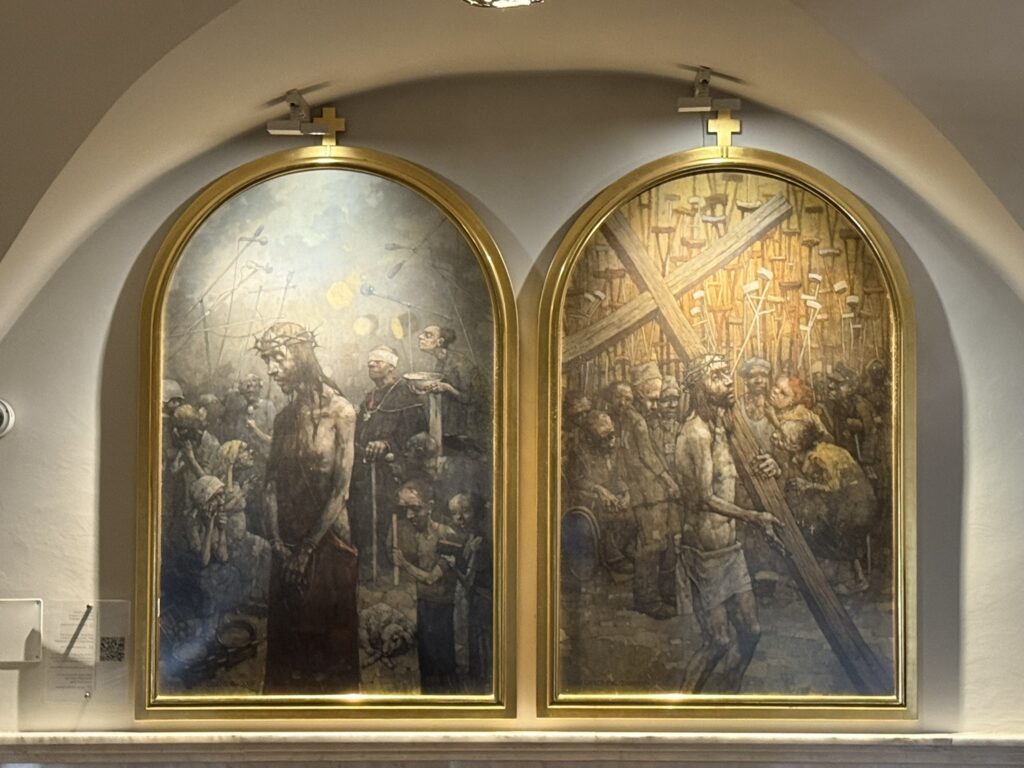
I was moved most deeply by the Golgotha of Jasna Góra, a series of eighteen Stations of the Cross painted by the Polish artist Jerzy Duda-Gracz. These are not comfortable or sentimental images. Duda-Gracz places the Passion of Jesus within the suffering of our own age and among people who are recognisably part of our world. Christ falls beneath the weight of human cruelty, indifference, exploitation and grief, while those around him watch, turn away or continue with their lives. These paintings will not allow the Crucifixion to remain safely in the past. Golgotha is here, Christ suffers among us now, and each of us must decide where we stand. I was completely unprepared for their power. As I moved from one Station to the next, I found myself in tears. They revealed the cost of the Cross, the reality of sin and the immeasurable love of Jesus with a force I had never encountered in any other Stations of the Cross. They remain one of the most powerful things I saw during the whole pilgrimage.
We travelled onwards to Levoča in Slovakia and then to Oradea in Romania. Pilgrimage draws us beyond the places we already know and the things we already understand. Again and again I was reminded that the Church is immeasurably larger than our parish, our diocese or our country. Languages, customs and styles of worship changed as we travelled, but the Mass remained the Mass, prayer remained prayer, and Christ remained at the centre.
From Romania we travelled through Serbia, visiting Belgrade and the great medieval monastery of Studenica. At Studenica, the depth of Christian history could be felt in every part of the monastery. It has stood through centuries of political upheaval, violence and change, yet the life of prayer has continued. The Church’s strength is not found in influence, fashion or institutional security. It is found in the quiet faithfulness of those who continue to pray.
Sarajevo and Mostar brought a different encounter. The beauty of Bosnia and Herzegovina stands alongside the visible wounds of a recent conflict. It is one thing to read about war and reconciliation, and another to travel through places where the scars remain on buildings and in the memories of those who live there. I found myself thinking about the fragility of peace, the terrible ease with which neighbour can be turned against neighbour, and the demanding Christian work of forgiveness.
In Mostar I entered the abandoned Ljubljanska Bank building, known now as the Sniper Tower. During the war, snipers used its height to watch the streets below and to kill those who crossed them. I climbed through the building and walked along its ruined corridors, past the scars of gunfire, layers of graffiti, discarded evidence of drug use and other signs of the darkness which had gathered there since the war.
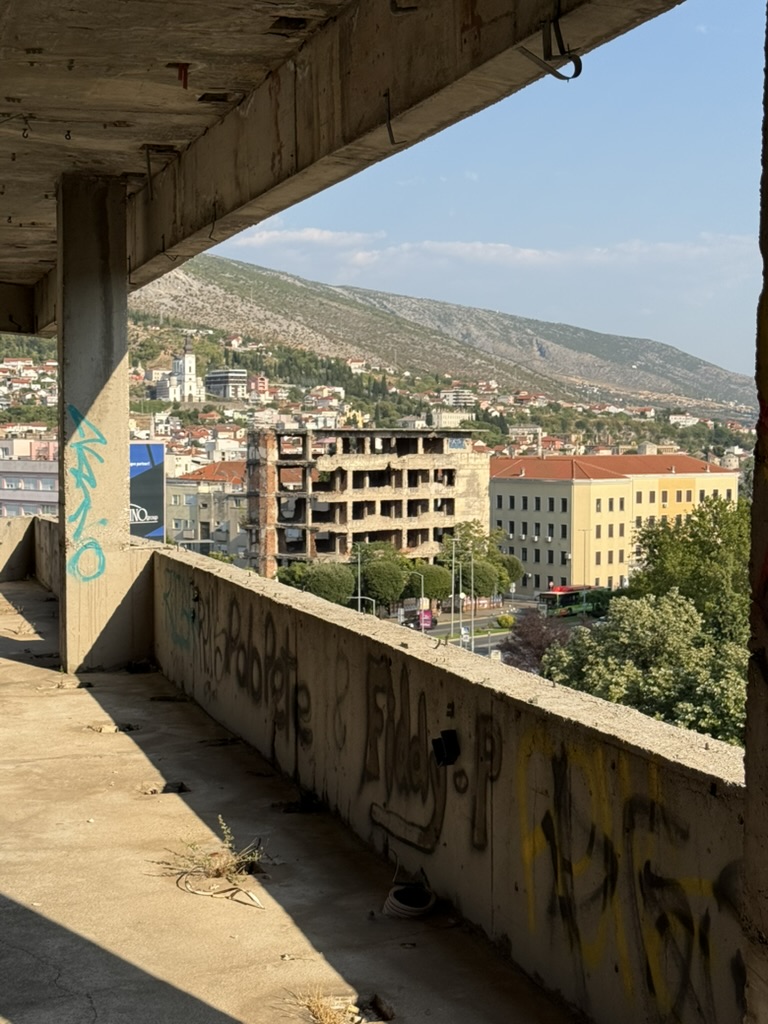
We often speak of holy places as ‘thin places’, where the division between earth and heaven has been worn thin and the presence of God feels especially close. Standing inside that building, I realised that there are places where the wall between earth and hell has also been worn thin. Violence, fear, hatred and human degradation had left their mark upon it. Evil is not an abstract theological idea. It enters human lives, inhabits human choices and leaves real wounds in people and places.
The building carried the memory of what human beings had done there, and what had followed afterwards. But to enter that place as a Christian is also to know that even there, hell does not have the final word. Christ descends into the darkest places, and the light shines in the darkness, and the darkness has not overcome it.
At Medjugorje we joined pilgrims from across the world in a place filled with prayer, conversion and devotion to Mary. People prayed with seriousness and confidence. Confessions were heard in many languages, rosaries were carried everywhere, and pilgrims came longing to be brought closer to God. That longing struck me most. People had travelled enormous distances because they knew that prayer mattered.
Crossing the Adriatic by ferry brought us into Italy. At Loreto we visited the Holy House, the home of the Holy Family brought from Nazareth. Its spiritual message is wonderfully clear. God chose to enter human life through an ordinary home and an ordinary family. The hidden life of Jesus at Nazareth tells us that holiness is not confined to churches, monasteries or dramatic moments. It is found in homes, kitchens, workshops and all the quiet places in which love is faithfully lived.
Assisi was every bit as beautiful as I expected, but St Francis remains unsettling as well as attractive. His life challenges the comfortable distance we create between the Gospel and the way we live. His simplicity, joy and love for Christ were not decorative additions to his faith. They were the consequence of taking Jesus at his word.
By the time we reached Assisi, we had endured temperatures above 40°C for more than nine days. Riding a heavily laden motorcycle in that heat was exhausting. There was no escape from it. The air rushing through my clothing was as hot as the air from a hairdryer, the motorcycle threw up more heat from beneath me, and every stop became an urgent search for shade and water.
Our plan had been to continue south to Rome and Naples, but Rome was forecast to reach 43°C and Naples was forecast to be hotter still. The area around Naples had also just suffered an earthquake. We made the decision to turn north and head towards the mountains in search of cooler air. Was that the right decision? Should we have endured the heat and pushed on? I still don’t know. Rome and Naples remain places I wanted to reach, and changing the route carried a real sense of disappointment. Pilgrimage, however, is not about forcing the journey to obey the plan.
Turning north gave us time to reach Kloster Einsiedeln in Switzerland, which had not appeared anywhere on our original schedule. It became another great place of prayer on the pilgrimage and a gift we would have missed if everything had gone according to plan. Things change, routes alter and new opportunities present themselves. That is one of the joys of pilgrimage. The unexpected is not an interruption to the pilgrimage. It becomes part of it.
The change also brought a much more personal joy. Catherine and Edmund travelled out by train, and I met them in Bern. After so many weeks away, seeing them again was wonderful. Catherine enjoyed the peace and cool air of the mountains, while Edmund joined me on the motorcycle for several days. Sharing part of the pilgrimage with him was a tremendous gift. Had we continued south according to our original plan, none of that would have happened. We lost Rome and Naples, but we received Einsiedeln, the mountains and precious days together as a family.
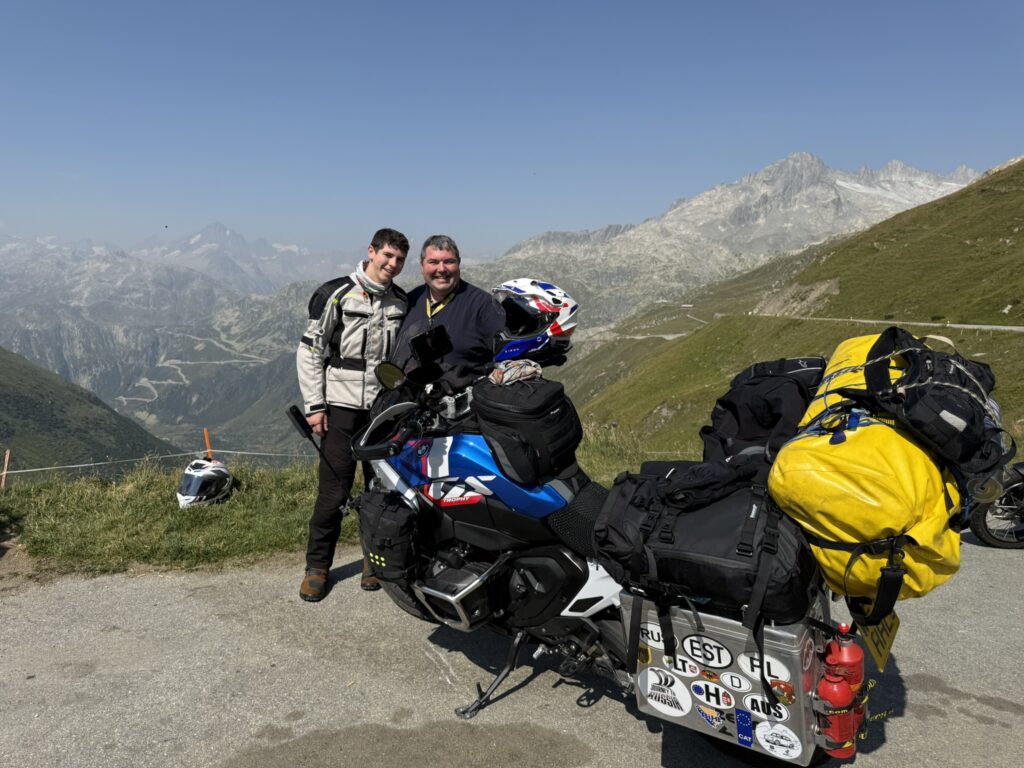
From Switzerland the pilgrimage carried us back into the mountains. Edmund joined me on the motorcycle as we crossed the Alps, passing beneath Mont Blanc and travelling onwards to La Salette in France. Sharing those roads with him made the mountains an even more precious part of the journey. Their scale and beauty make it impossible to imagine ourselves as the centre of creation. High among them, La Salette gave us stillness, prayer and the call to return to God.
We then crossed into Spain, travelling through Puigcerdà and on to Montserrat, where the monastery grows from the extraordinary mountain around it. The mountain, the monastery and the devotion to Our Lady belong together. It is a place formed by prayer and by the faith of countless pilgrims who have climbed the mountain to seek God.
From Montserrat we rode across Spain through Guadalajara and onwards to Fátima in Portugal. Fátima was one of the most powerful places of the whole journey. The scale of the shrine is immense, yet its heart is the small Chapel of the Apparitions. The shepherd children encountered Our Lady in an obscure Portuguese village, and that encounter has drawn millions of people to prayer, repentance and faith in Jesus.
From Fátima we turned north to Santiago de Compostela and stood at the tomb of St James, the destination towards which pilgrims have walked for more than a thousand years. Arriving by motorcycle is different from arriving on foot, but there was still a profound sense of reaching a destination in the company of the countless pilgrims who had travelled there before us.
Our final great shrine was Lourdes. By then we were tired, and its message was wonderfully clear. Lourdes is a place of sickness and suffering, but it is also full of hope, gentleness and joy. The sick are not hidden away or treated as an inconvenience. They are placed at the heart of the life of the shrine. Lourdes offers a beautiful glimpse of the Church as she ought to be.
The other wonderful side effect of being away from the parish is that I had a great deal of time to pray for you all, a great deal of time to think, and I grew to miss you greatly as well.
In the day-to-day cut and thrust of life we can begin to take relationships and friendships for granted. A little time apart, as the old saying goes, makes the heart grow fonder. The pilgrimage took me to some of the great holy places of Europe, but it also forced me to remember that God is present here – in our churches, in our homes, in our friendships and in the ordinary shared life of our parish.
After thirty-five days on the road, it is very good indeed to be home.
In love,
Fr. Matthew
Sunday 13th September
24th Sunday in Ordinary Time 🟢
9am – Sung Parish Mass, SJ
11:15am – Sung Parish Mass, SL
Year A(II), Psalm week 4, Trinity 15, Proper 19
Upcoming Dates
Sept
10th – Winter Term & Christmas Planning Meeting [SL]
11th – Bingo [SL]
20th – Lecture, Church Vestments (4pm) [SJ]
Afternoon Tea (5pm) [SJ]
Evensong (6pm) [SJ]
27th – NA Benefice Evensong, St. Mary’s
[SJ] St. John’s | [SL] St. Luke’s | [WH] Wickham Hall
[SC] St. Catherine’s School